
How Did the Twelve Months Get Their Names?
Discover the fascinating history behind the names of the twelve months, their Roman and Latin origins, and how the Gregorian calendar evolved over time. This in-depth guide explains January to December with accurate historical facts, making it perfect for readers interested in history, calendars, timekeeping, and ancient civilizations.
NEWS ALERTS
12/13/20254 min read
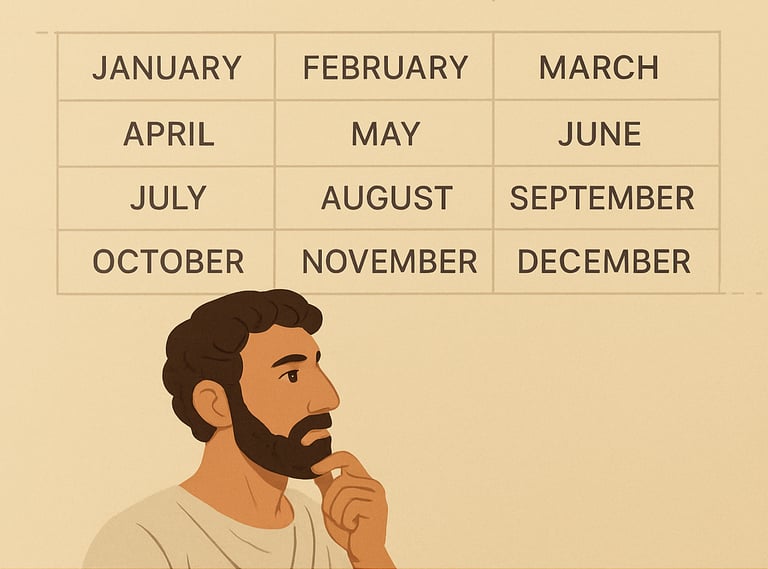
How Did the Twelve Months Get Their Names?
Introduction to the Gregorian Calendar
Ever looked at a calendar and wondered why the months are named the way they are? You are not alone. The Gregorian calendar, the system most of the world uses today, feels modern, but its roots stretch deep into ancient Rome. Think of it like driving a brand-new car with an engine designed two thousand years ago. The structure may be refined, but the core ideas are ancient.
The Gregorian calendar consists of 365 days divided into 12 months, with a leap year adjustment every four years. While the math keeps our seasons aligned, the names of the months tell stories—stories of gods, emperors, rituals, and political power.
Origins of the Roman Calendar
Before the Gregorian calendar existed, Romans used an early lunar calendar believed to have been introduced by Romulus, the legendary founder of Rome. That calendar had only 10 months, starting in March and ending in December. The winter period was essentially ignored, unnamed, and uncounted.
Later, Roman king Numa Pompilius added January and February, bringing the total to 12 months. These names stuck, even as the calendar continued to evolve.
Transition from Roman to Gregorian Calendar
Fast forward to 46 BCE, when Julius Caesar introduced the Julian calendar, aligning months with the solar year. However, small inaccuracies accumulated over centuries.
In 1582, Pope Gregory XIII reformed the system, giving birth to the Gregorian calendar we use today. Importantly, while the structure changed, the month names remained untouched, preserving their ancient origins.
Why Month Names Still Matter Today
Month names are more than labels. They are linguistic fossils, carrying Roman religion, politics, and culture into modern life. Every time you say “March” or “July,” you are echoing history without realizing it.
January
Roman Mythology Behind January
January is named after Janus, the Roman god of beginnings, endings, and transitions. Janus had two faces—one looking backward, one forward.
Symbolism of Beginnings
The Latin word Janua means “door.” January is the doorway to the year, making it the perfect month to start fresh. January has 31 days.
February
Purification and Rituals
February comes from Februa, Roman purification festivals meant to cleanse the city and prepare for renewal. It was a spiritual reset button.
Leap Year Significance
February has 28 days, or 29 in leap years, added to correct Earth’s orbit around the sun. Short, but scientifically vital.
March
Mars and Warfare
March honors Mars, the god of war. It was once the first month of the Roman year.
Spring and Agriculture
March marked the start of military campaigns and farming season—when both soldiers and seeds went into the ground. It has 31 days.
April
Etymology of Aprilis
April likely comes from aperire, meaning “to open.” Flowers bloom, trees awaken, and nature stretches after winter.
Seasonal Symbolism
April has 30 days and represents rebirth and growth.
May
Goddess Maia and Growth
May is named after Maia, symbolizing fertility and abundance.
Cultural Associations
It is a month linked to expansion—of crops, ideas, and life itself. May has 31 days.
June
Juno and Family
June honors Juno, protector of women and families.
Marriage Traditions
This is why June remains a popular wedding month. June has 30 days.
July
Julius Caesar’s Legacy
Originally called Quintilis, it was renamed July to honor Julius Caesar after his death.
Calendar Reforms
Caesar’s reforms stabilized the calendar, earning him eternal recognition. July has 31 days.
August
Augustus Caesar
August honors Augustus Caesar, Rome’s first emperor.
Political Influence on Timekeeping
The name Augustus means “venerable.” Like July, August has 31 days, reinforcing imperial prestige.
September
Numerical Naming System
From septem (seven), September was once the seventh month. It now has 30 days, but the name stayed.
October
Why the Name No Longer Matches the Number
Derived from octo (eight), October is now the tenth month. It has 31 days.
November
Latin Roots Explained
From novem (nine), November shifted position but not identity. It has 30 days.
December
End-of-Year Meaning
From decem (ten), December once closed the Roman year. Today, it ends with 31 days and global celebrations.
How the Calendar Influenced Modern Society
Our work schedules, holidays, fiscal years, and even school terms are shaped by these ancient decisions. The calendar is a silent architect of daily life.
Common Myths About Month Names
A popular myth claims months were renamed randomly. In reality, each name reflects deliberate cultural, religious, or political choices.
Conclusion
The names of the twelve months are not random labels—they are living relics of Roman mythology, language, and power. Despite reforms and scientific adjustments, their names survived unchanged, bridging ancient Rome and the modern world. Every calendar page is a quiet history lesson hiding in plain sight.
FAQs
1. Why are September, October, November, and December numerically incorrect?
Because the Roman calendar originally started in March.
2. Who named the months July and August?
They were renamed to honor Julius Caesar and Augustus Caesar.
3. Why does February have fewer days?
It was linked to purification rituals and later adjusted for leap years.
4. Are month names the same worldwide?
Many languages adapt Latin-based names, though some cultures use unique systems.
5. Is the Gregorian calendar still accurate today?
Yes, it remains the most precise civil calendar currently in use.

Stay updated with the latest from elysam
Contact
Subscribe
info@elysam.com
+923170016364
© 2025. All rights reserved.
© ProHeaven Sports – Official Store | Powered by ELYSAM